What the SEC Letter on Canton Coin Actually Says
The Division of Corporation Finance says Canton Coin is a digital commodity. Here is what the letter establishes, what it rests on, and what it deliberately leaves open.
On 3 November 2026, the SEC’s Division of Corporation Finance issued a no-action letter on Canton Coin. Within hours the headlines had flattened it into something it does not say. The letter is significant, and it is worth reading carefully rather than through a summary of a summary.
What happened
The Office of Chief Counsel in the Division of Corporation Finance responded to a request letter dated 30 October 2026. The response is signed by Jonathan A. Ingram, Deputy Chief Counsel.
Two things follow from it.
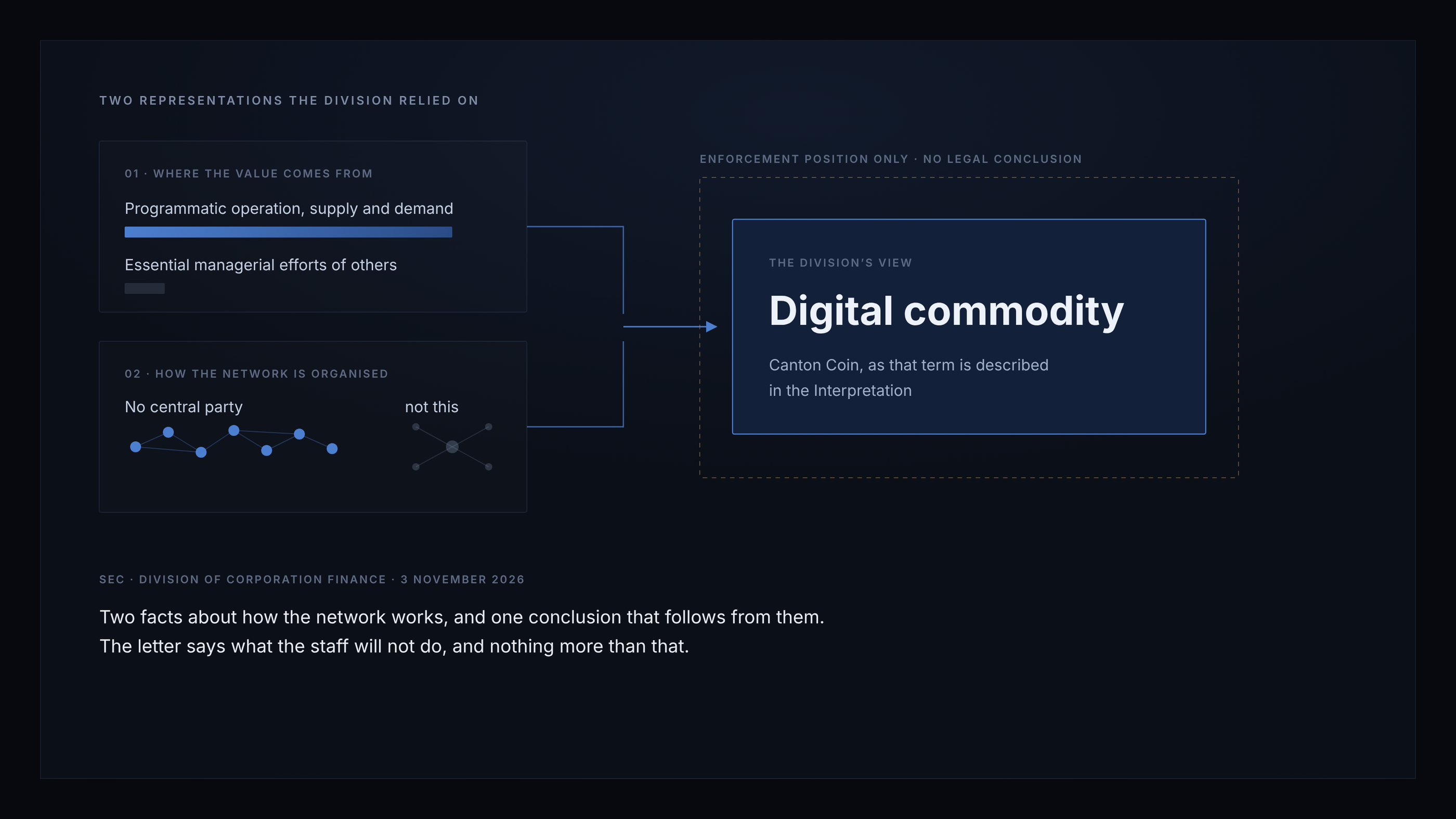
First, in reliance on the representations made to it, the Division states that it is of the view that Canton Coin is a “digital commodity,” as that term is described in the Interpretation.
Second, the Division states that it will not recommend enforcement action to the Commission where Canton Coin is minted programmatically by Super Validators, Validators and application providers, in the manner described, without registration under Section 5 of the Securities Act or Section 12(g) of the Exchange Act.
The reasoning is the interesting part
A conclusion without reasoning tells you very little. This letter gives its reasoning, and the reasoning is where Canton’s architecture shows up.
The Division particularly notes two representations. The first is that Canton Coin is intrinsically linked to, and derives its value from, the programmatic operation of the Canton Network and from supply and demand dynamics, rather than from the expectation of profits generated by the essential managerial efforts of others. The second is that the Canton Network has no “central party” as that term is defined in the Interpretation.
Read those two together and the position is not really about a token at all. It is about how a network is built. A coin whose issuance and value are produced by the operation of the protocol itself, on a network with no central party directing it, sits in a different place than a coin whose holders are waiting for a company to deliver returns. That distinction is old. What is new is seeing it applied this cleanly to a network of this kind.
What the letter does not say
This part matters as much as the rest, and it is where most of the coverage is getting it wrong.
The letter does not say that Canton Coin is not a security. It does not make that finding, and it does not need to. The Division’s position is about enforcement, and the letter states in plain terms that it “does not express any legal conclusion on the issues presented.”
It also rests entirely on the facts as presented. The letter says so directly: the positions are based on the representations made to the Division, and any different facts or conditions might require the Division to reach different conclusions.
That is how no-action relief works everywhere, not a caveat specific to this case. It is not a court ruling and it is not a rule. It is the staff telling you, on these facts, what it will not do.
None of that makes the letter weak. Staff positions of this clarity are rare, and the market reads them for what they are.
Why it matters
Institutional capital does not move into infrastructure it cannot assess. Risk committees do not approve what they cannot classify. For the last several years the honest answer to “what is this asset, legally” has been a shrug dressed up in footnotes, and that shrug has been a real constraint on adoption, more than throughput or tooling ever were.
A no-action letter does not remove that constraint entirely. It does narrow it, and it narrows it on reasoning that other networks cannot simply borrow. The grounds the Division relied on, programmatic value and no central party, are properties of how Canton was designed rather than claims made about it.
For everyone building on Canton, that is a meaningful step forward.