The network that cannot outgrow its own usage
Yuval Rooz argued in May that most token valuations have no utility underneath them. This is what his argument looks like from the operator side.
Most token valuations are a story about the future. A few are arithmetic about the present. The difference matters more than the crypto market has been willing to admit.
Yuval Rooz, co-founder and chief executive of Digital Asset, put the uncomfortable version of this plainly in May. Strip the priority fees out of a network's revenue, look only at what people paid for actual utility, and the valuation multiples that come back are in the thousands. No operating business on earth trades anywhere near that. He called the gap what it is, a story sold to retail, and argued that retail investors have been carrying networks whose utility never arrived.
We operate infrastructure rather than write market commentary, so we want to take that argument somewhere specific: what it looks like from underneath, where the transactions actually land.
Fees are not one thing
The first useful distinction is between a fee paid for utility and a fee paid for position.
A priority fee is not payment for a service. It is payment to be first in a queue, usually by an arbitrageur capturing a spread that exists only because the queue exists. That money does not represent someone using the network to do something. It represents someone extracting from people who are.
Both show up in the same revenue chart. Only one of them tells you whether anything is being built.
Why the denomination matters
Canton prices its fees in dollars rather than in its own token. That sounds like an accounting detail and it is not.
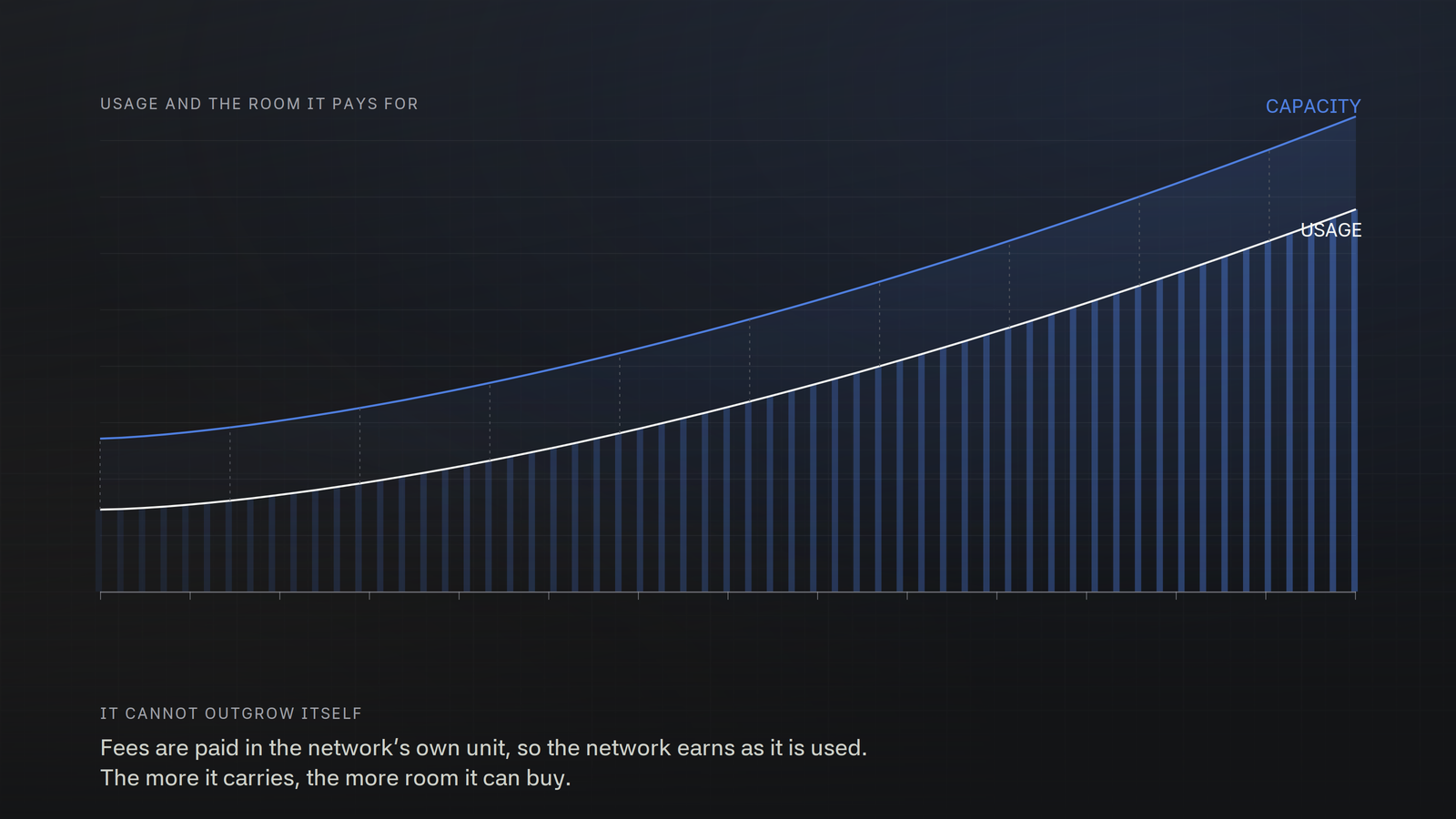
If a fee is a fixed number of tokens, then the network's revenue rises and falls with the token price, and the token price can be moved by anyone with capital and an afternoon. If the fee is a fixed number of dollars, the token amount is derived at the moment of the transaction, and the only way to increase the tokens consumed is to increase the dollar value of what the network is actually doing.
That inversion is the whole mechanism. Speculation cannot manufacture burn. A higher price means fewer tokens consumed for the same work, which makes the network more dilutive rather than less. Usage is the only input that moves the number in the right direction.
It is an unusually honest design, because it removes the most convenient lever a network has.
What it looks like from the operator side
We run validator infrastructure and we build products that sit on the network, so we see the same mechanism from the cost side rather than the narrative side.
Two things follow from it.
The first is that our revenue is tied to whether anyone uses what we build. Canton directs the larger share of its rewards to the applications and assets that generate real traffic, rather than to validators alone. That is a deliberate choice about who the network wants to attract, and it means a team that ships something nobody uses earns nothing, however good the deck was.
The second is more practical. A customer's finance team can model the cost of using this network a year out, because the fee is a dollar figure rather than a bet on a token price. That sounds mundane next to a tokenomics thread. It is also the single question that decides whether a bank's budget process ever approves the line item.
The part that has to be true
None of this works on its own. A mechanism that ties value to usage is worthless without usage.
What makes the argument interesting now is that the usage has started to be real. Broadridge's repo platform settled around $368 billion in average daily volume on Canton in April 2026, close to $8 trillion for the month, up roughly 268 percent year over year. DTCC is moving US Treasuries and equities onto the network. JPMorgan is bringing tokenized deposits. Goldman's digital asset platform runs on it natively.
These are not pilots looking for a use case. They are existing businesses moving existing volume, which is the only kind of adoption that survives a bad quarter.
The honest caveat
A design that refuses to reward speculation will underperform one that rewards it, for as long as speculation is what the market is paying for. That is not a flaw in the mechanism. It is the mechanism working, and it will look like underperformance right up until it does not.
The question worth asking about any network is narrow. Strip out the fees paid to jump the queue, and what is left? If the answer is a rounding error after several years in production, no amount of throughput fixes it.
We build here because the arithmetic points in the same direction as the work. The network becomes more valuable when more real business runs through it, and there is no other path to the same result. For an infrastructure business, that is a comfortable place to stand.