One Network, One Price: What Canton's Universal Burn Changes
Five North co-authored and sponsored CIP-0129. Here is what Universal Burn means for builders, institutions and Canton Coin holders, in the words of its authors.
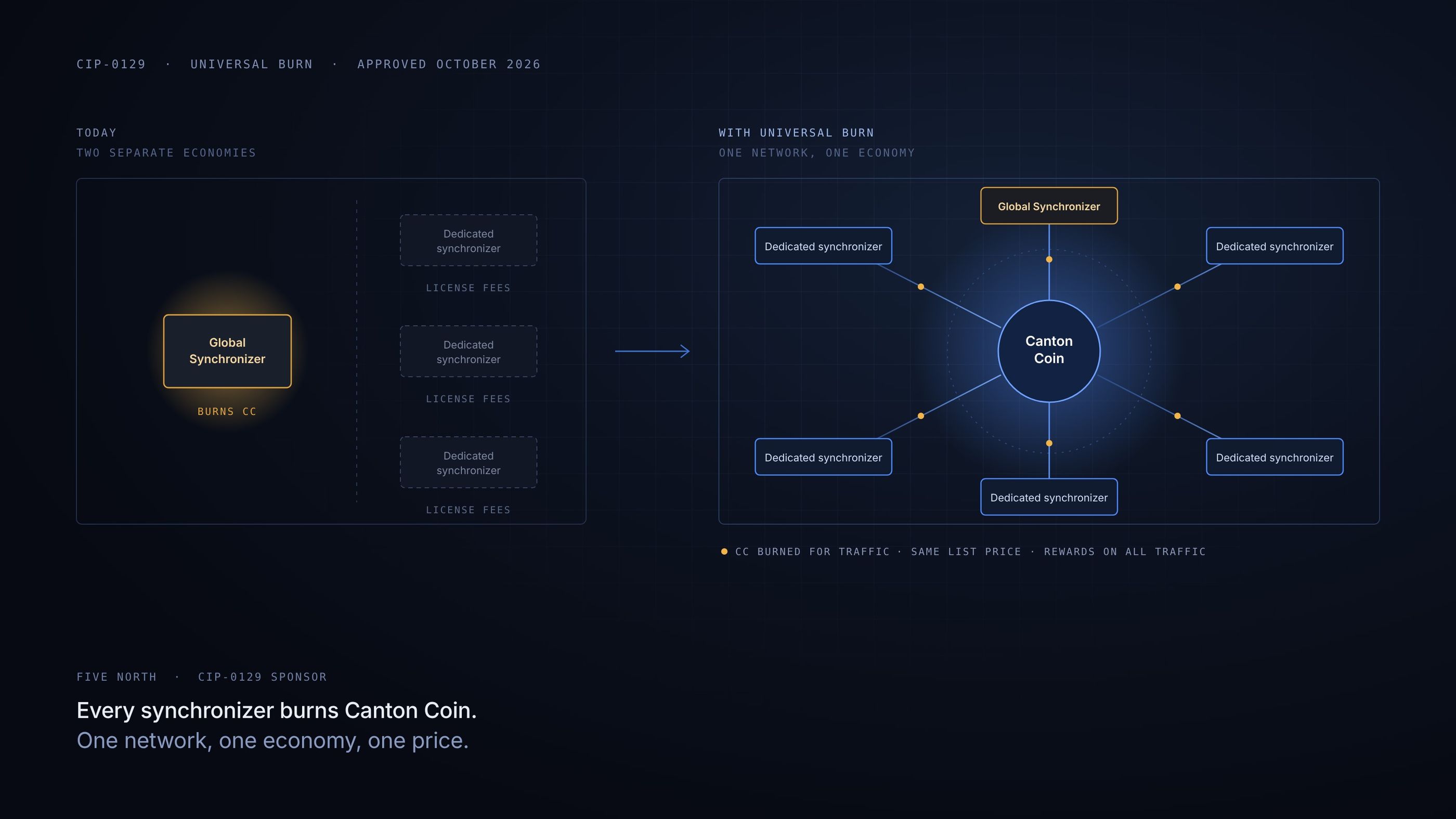
In October, Canton's Super Validators approved CIP-0129, known as Universal Burn. Once it is live, every synchronizer on Canton MainNet will burn Canton Coin (CC) for traffic and earn rewards on the same model as the Global Synchronizer. One network, one shared economy.
The proposal was written by Five North founder Yiannis Varelas and Shaul Kfir, co-founder of Digital Asset, and Five North sponsored it. On 3 November, the two joined James Kay of Digital Asset for an X Space to explain what it means. Here are the key points.
Why Five North backed it
Until now, dedicated synchronizers sat outside Canton's economy. They have been paid for through license fees to Digital Asset, while only the Global Synchronizer burned CC.
Yiannis said the timing was right. The network is past its bootstrap phase, it has traction, and the stakeholders were aligned. The goal is to "make sure that everybody pays their fair share by using the network", and to do it as one network, not fragmented like L2s that do not take part in the main economy. Getting the design right took three to four attempts.
Shaul added that this has always been Canton's north star. Waiting for it before launch would have delayed the network by two or three years. He also publicly thanked Yiannis and the Five North team for raising their hand to lead the work.
More than burn
"I see that as a means to an end," Shaul said about the burn. For him, Universal Burn enables two things Canton was designed for.
The first is horizontal scalability. On the internet, a successful company adds servers and capacity. It does not compete for a fixed amount of space. Canton works the same way: a successful app can add capacity instead of pushing prices up for everyone else.
The second is control. Some institutions need it for local jurisdiction, for example rules that critical infrastructure must run in the country. Others need service level agreements and a failover plan. Others want certainty that their data is deleted, given future quantum and AI risks. Dedicated synchronizers give them that control without leaving the network.
Universal Burn makes sure value flows to token holders in one simple way, and that wallets, apps and users have one way to pay, wherever the traffic runs.
What will change
- Every production synchronizer will burn CC at the same list price, currently $60 per MB, about $1 for a typical transaction before rewards.
- Running a dedicated synchronizer will no longer require a license.
- Apps and validators will earn rewards on all traffic, wherever it runs.
- Issuance and the reward split will not change.
For existing dedicated synchronizers, the main change is that they will buy traffic themselves instead of paying a license. Applications will not need to change. Institutions that prefer to pay in US dollars under a regular contract can keep doing so through a paymaster, who handles the burn for them.
One mainnet
"Mainnet is the entire Canton economy," Shaul said. "Any two assets, any two services, any two customers or users who can connect to each other are all part of mainnet." His hope is that in a few years, no one will ask which synchronizer they use, in the same way most people never think about which DNS server their computer uses.
What it means for builders
"Nothing changes on the UX of the developer or the user with this CIP," Yiannis said.
The default is to start on the Global Synchronizer. A dedicated synchronizer makes sense later, for legal or regulatory reasons, security, resilience, or very high throughput. It is not an upfront decision: contracts can be reassigned between synchronizers, and the node routes traffic automatically.
For institutions, the bigger change is access. Assets that were built on their own islands, such as tokenized deposits, can connect to the public network if the issuer chooses. That makes token standard compliance and working with many wallets far more important.
Pricing and discounts
Canton does not need to auction block space, because capacity can be added. So the Global Synchronizer keeps one stable price in US dollars that does not move with the price of CC.
Dedicated synchronizers can get volume discounts for sustained throughput. A $10 payment cannot carry a $1 fee, so lower unit costs at high volume open the door to use cases like agentic and card-style payments. Operators can also get commitment discounts by committing to throughput for a year or more, backed by CC collateral. Shaul called the locking "a necessary evil" of a permissionless network, since it is the only way to enforce a commitment. It also takes coins out of circulation and creates lending demand for CC. The exact numbers will be set in a later CIP.
Feedback shaped the proposal too. An early idea of a minimum burn of around $250,000 a year for dedicated synchronizers was dropped, because it would have priced out smaller players.
What it means for CC holders
"We are coin holders. We want to increase burn. We do not want to increase inflation," one of the speakers said.
Because Canton is not limited by block space, the aim is to bring as many use cases as possible onto the network. Every dedicated synchronizer burns CC, and that value flows to the network and its holders. Yiannis said at least 10 high-burn apps reached out to test it as soon as the CIP was published.
What comes next
The parameters are included in Splice 0.10, so testing can start on DevNet and TestNet. Alpha testing with early adopters is expected to start in the coming weeks.
- Q1 2027: the first users run dedicated synchronizers and burn CC. Use cases will be selected carefully and approved by a Super Validator vote, with some permissioning until the full trust model is ready.
- Mid-2027: the full version, including the discount curve, after further CIPs.
Both speakers stressed that these are estimates, not commitments, and that burn will grow gradually rather than jump overnight. The direction is clear: one network, one economy, one price.